Ghana’s supreme court clears path for controversial anti‑LGBTQI bill


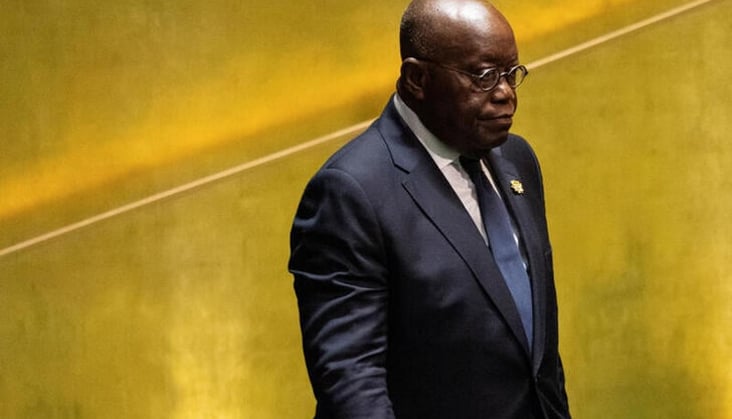
Outgoing Ghana President Nana Akufo-Addo. (REUTERS/Caitlin Ochs)
Ghana President Nana Akufo-Addo. (REUTERS/Caitlin Ochs)

The decision by Ghana’s apex court is expected to shift the focus to outgoing President Nana Akufo-Addo, who must now decide whether to sign the bill into law before his term ends on 6 January 2025.

The Supreme Court of Ghana has unanimously dismissed two legal challenges seeking to prevent the passage of the controversial anti-LGBTQI bill, clearing the way for its potential enactment.

“Upon hearing the parties orally, we come to the unanimous decision that the plaintiff writ does not properly invoke the exclusive jurisdiction of this court,” Justice Avril Lovelace-Johnson, president of the seven-member Supreme Court panel, said in the ruling on Wednesday.

“It will be premature for this court to exercise its interpretive and enforcement jurisdiction to intervene. Consequently, the action fails. Until there is presidential assent to the bill, there is no act of which the Supreme Court will use its supervisory jurisdiction to overturn. The plaintiff’s action is therefore dismissed.”

The decision is expected to shift the focus to outgoing President Nana Akufo-Addo, who must now decide whether to sign the bill into law before his term ends on 6 January 2025. If he opts not to act, the incoming President John Mahama, who supported the bill while in opposition, will face the decision.

“We are disappointed. This will embolden people to trample on the rights of [the] minority in society. We will study the judgement and advise ourselves accordingly,” says Takyiwaa Manuh, an emerita professor of African Studies at the University of Ghana, who has led civil society to kick against the bill.

A controversial bill

Officially named the ‘Human Sexual Rights and Family Values Bill’, the legislation has sparked fierce debate since its passage in February. The bill criminalises LGBTQ relationships, with penalties ranging from six months to three years in prison, and imposes even harsher sentences of three to five years for promoting or sponsoring LGBTQ activities.

The bill has drawn widespread international condemnation from organisations such as the United Nations and foreign governments, including the United States and the United Kingdom, which have urged Ghana to respect human rights.


Despite this, the legislation enjoys strong domestic support in the deeply conservative West African nation, where influential Christian, Muslim, and traditional leaders have backed the bill. A coalition of MPs also overwhelmingly approved it in February.

Legal and economic stakes

The lawsuits filed by broadcaster Richard Dela Sky and academic Amanda Odoi challenged the constitutionality of the bill and sought to prevent its transmission to President Akufo-Addo for assent.

Sky argued that the bill violated multiple provisions of Ghana’s 1992 Constitution, including protections against discrimination and guarantees of personal freedom. Among his eight reliefs, he claimed that the Speaker of Parliament had breached constitutional provisions by passing a bill that imposes charges on the Consolidated Fund.

Odoi, on the other hand, sought a restraining order to stop parliamentary leaders from forwarding the bill to the president.

Both cases were dismissed by the court for failing to properly invoke its jurisdiction. The court ruled that intervening in the legislative process before presidential assent would be premature and outside its purview.

The bill’s passage has also raised significant economic concerns. Ghana’s finance ministry has warned that the country risks losing $3.8bn in World Bank financing as a result of the bill.

Outgoing President Akufo-Addo has refrained from approving the bill, citing the legal challenges. However, with the court’s dismissal of the cases, he may now face mounting pressure from both supporters and detractors to act before leaving office.

Comments

Popular posts from this blog

Syrian security forces accused of executing dozens of Alawites

  Syrian security forces are alleged to have executed 52 people belonging to the Alawite minority in the coastal province of Latakia, according to one war monitoring group. Footage seen by the British-based Syrian Observatory for Human Rights shows dozens of bodies in civilian clothing piled up in the garden of a house in Latakia. An interior ministry source told the country's official news agency Sana said that "individual violations" had occurred on the coast and pledged to put a stop to them. BBC News has not been able to verify claims that the killings were committed by the forces of Syria's new rulers. This followed clashes   between government forces and fighters loyal to the deposed President Bashar al-Assad , which left more than 70 dead. A curfew has been imposed in the cities of Homs, Latakia and Tartous, where the fighting has broken out. Earlier, BBC Verify confirmed two videos that showed a body being dragged behind a car in Latakia. The United Nation...

Wike not right for unity, Atiku defends Okowa’s choice

  The 2023 Presidential candidate of the Peoples Democratic Party, Atiku Abubakar has clarified that he rejected former Rivers State Governor Nyesom Wike as his running mate in the election because Wike was not suitable for a ticket intended to promote unity rather than division. In a statement released by his media office on Saturday, Atiku explained that he chose former Delta State Governor Ifeanyi Okowa as his running mate in 2023 due to a combination of intellect, composure, and statesmanship. Atiku in a recent interview stated that he did not regret rejecting Wike as his running mate in the 2023 presidential election. The former Vice President revealed that a committee had presented him with three potential candidates: former Delta State Governor Ifeanyi Okowa, Wike, and ex-Akwa Ibom Governor Udom Emmanuel. He announced that Okowa was selected as the running mate because he scored the highest. In response, Wike, through his media aide Lere Olayinka, dismissed Atiku’s comments,...

Save me from the burden that isn’t mine” – Jumoke Odetola cries out to God

  Actress and producer Jumoke Odetola has lamented over the current state of social media, criticizing the prevalence of “clout chasing” and a lack of emotional intelligence, self-awareness, and common sense among users. In an Instagram post, Odetola described how interacting with people who lack these qualities can be mentally draining.  She also expressed her exhaustion with feeling secondhand embarrassment from individuals she neither knows nor engages with. Turning to faith, she prayed for strength to ignore negativity, remain unbothered, and avoid wasting time on issues that do not concern her. She wrote: “In this age and time where clout chasing is the new currency and lots of people do not even know where and when to draw the line. “If you still have common sense, emotional intelligence, social awareness, and self-awareness. I bet you don’t realize how blessed you are. The irony is it’s a blessing wrapped in thorns, those who lack these basic qualities can be incredibly...